It is not too late, and you are not unusual
Plenty of adults living in Dubai cannot swim. Some grew up somewhere without pools, some had a frightening experience as a child, and some simply never got round to it. None of that makes learning as an adult strange or embarrassing.
Adults arrive at a first lesson from one of three starting points: never having been in water above the waist, being able to splash about but not to swim a length, or being able to swim but with technique that tires them out within twenty metres. All three are common, and all three are taught the same way, by starting from what the swimmer can already do rather than from a syllabus.
It is also worth knowing that this is not only a comfort question. The World Health Organization reports around 300,000 drowning deaths worldwide each year, and lists teaching basic swimming and water-safety skills among its recommended drowning-prevention measures. Learning as an adult is a safety skill, not a hobby you missed.
Why adults often progress faster than they expect
Adults have two clear advantages over children. They can follow a verbal instruction precisely, and they can practise a correction deliberately rather than stumble onto it. Told to breathe out slowly through the nose while the face is in the water, an adult can do exactly that on the very next attempt.
The disadvantage is that adults think more. A child who slips underwater usually comes up laughing. An adult predicts the moment, tenses the shoulders and holds their breath, which makes floating harder and the whole experience less pleasant than it needs to be.
Most of an adult beginner lesson is therefore spent removing tension rather than adding technique. Once the shoulders drop and the breathing slows down, buoyancy and balance tend to arrive largely on their own.
A fear of water is a normal response, not a character flaw
Fear of water in adults almost always attaches to something specific rather than to water in general. The usual candidates are not being able to touch the bottom, putting the face under, getting water up the nose, and the loss of control that comes with floating on the back.
Naming the specific fear matters, because each one has a different and quite practical answer. A swimmer who is only afraid of deep water can make real progress for weeks without ever leaving a depth where they can stand.
Nobody gets pushed into the deep end. A lesson for a nervous adult can spend its entire first hour in chest-deep water, and that is a perfectly good first lesson if the swimmer leaves calmer than they arrived.
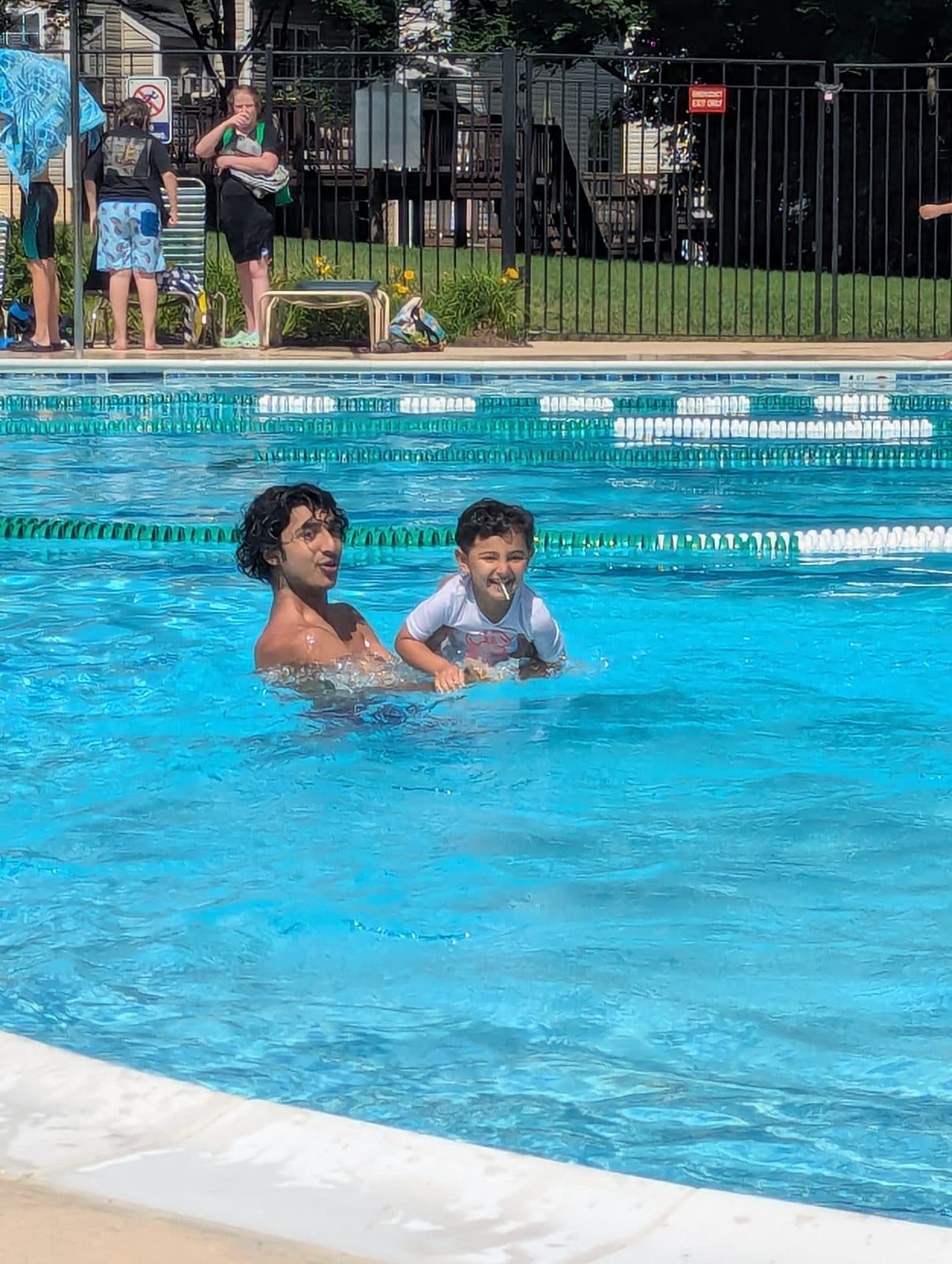
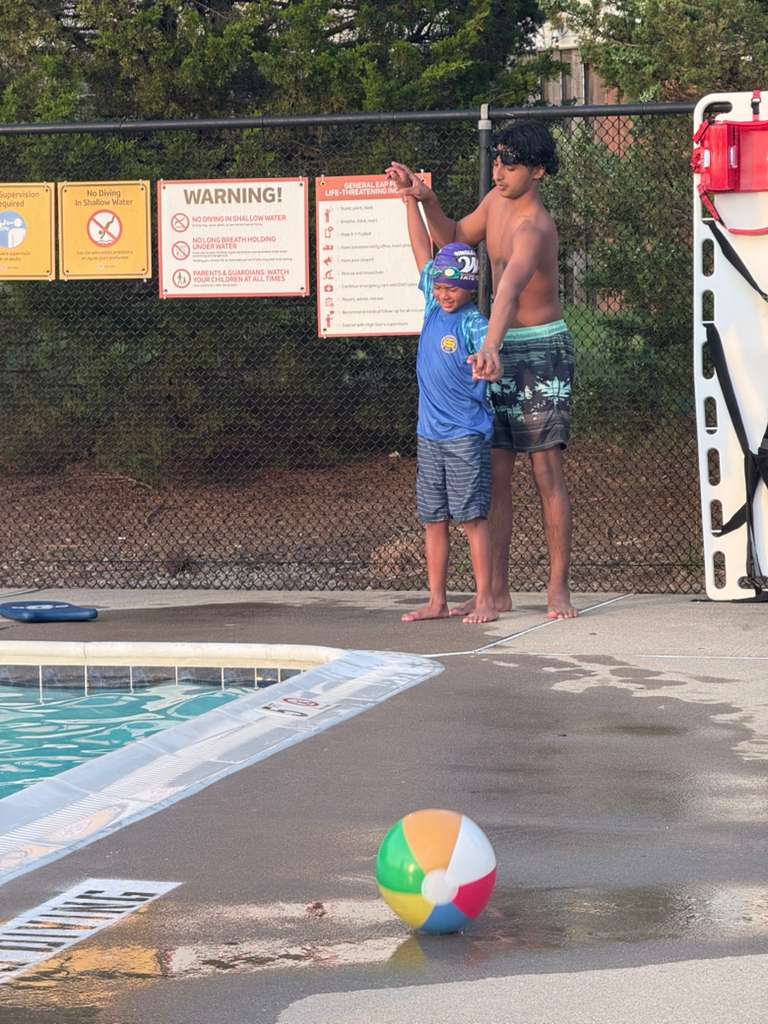
Rehan Ahmad trained as a lifeguard with Prince William County Parks and Recreation in CPR, first aid, AED use and water rescue, so the person in the water with you is trained to manage the water as well as to teach it.
What a first adult lesson usually looks like
The exact order changes with the swimmer, but a first hour for a nervous adult tends to move through the same stages, and it stops wherever the swimmer is genuinely comfortable rather than wherever the plan said it would.
- Standing in shallow water and getting used to the temperature and the feel of it
- Putting the mouth, then the nose, then the eyes into the water while holding the side
- Blowing slow bubbles out, which is the single most useful habit in swimming
- Floating on the front with support, then without it
- Floating on the back, which most adults find harder and which matters more
- Gliding a short distance off the wall
- Adding a kick, then an arm stroke
Breathing is what separates swimming from surviving
The most common reason an adult cannot swim more than a few metres is not weak arms or weak legs. It is that they are holding their breath. Holding air in keeps the body tense and makes the next breath urgent, which is why a single length can feel like a sprint.
The correction is to breathe out continuously while the face is in the water, so that the only job on the breath is to breathe in. That one change turns a panicked twenty-five metres into something a swimmer can repeat.
It takes practice rather than talent. Most adults can do it standing in the shallow end within one lesson, and can do it while actually swimming within a few more.
Learning privately, at your own pool, with nobody watching
The reason many adults in Dubai never book swimming lessons is not cost or time. It is the prospect of being the only adult beginner in a class, in a public pool, in front of strangers.
A private lesson removes that completely. Rehan Ahmad travels to the swimmer's own villa pool, their building's shared or podium pool, or a community pool they have access to, anywhere in Dubai. The only two people involved in the lesson are the swimmer and the coach.
If you have no pool access at all, Rehan can arrange one. The hire or entry cost of that pool is billed on at cost and confirmed before you book, so the full price is known in advance.
Pool rules vary from building to building in Dubai, and some managements ask for advance notice before an external coach teaches on the premises. A quick message to your building management before the first lesson is worth the two minutes it takes.
Adults who can already swim: fixing the technique
Not every adult booking a lesson is a beginner. A large share of adult lessons are for people who can get from one end to the other but find it exhausting, who want to swim for fitness, or who are training for the swim leg of a triathlon and need it to stop costing them so much.
Those lessons look different. They are mostly stroke correction: body position, head position, the catch, rotation, and above all the timing of the breath. Small changes to any of these produce large changes in how far a swimmer can go before they are tired.
Rehan Ahmad swam competitively with Occoquan Swimming and with the Potomac Marlins in their Senior Gold group, with personal bests of 23.67 for 50 yards freestyle, 51.17 for 100 yards freestyle and 1:03.36 for 100 yards breaststroke. Those results are public on SwimCloud, which is unusual for a private coach and worth checking before you book anyone.
What it costs, and how to start
A single one-hour private lesson with Rehan Ahmad is AED 200. A four-lesson pack is AED 600, which is AED 150 a lesson, and an eight-lesson pack is AED 1,000, which is AED 125 a lesson. There is no contract and no sign-up fee, and any equipment the lesson needs is included.
Two things are charged on top and both are confirmed before you book: travel to your location, priced by distance, and the hire or entry cost of any pool Rehan arranges for you.
For context, private at-home rates observed in the Dubai market during 2026 included ProFit Swimming at AED 300 a lesson, Swimmers.ae at AED 300, and Emad Health Club at roughly AED 230 a lesson within a ten-lesson pack. Aqua-Tots in Al Quoz offers a private option of AED 1,300 a month for four thirty-minute lessons at its own centre. When comparing, check the lesson length, because an hour of one-to-one coaching and a thirty-minute slot are not the same product.
The first step is a free thirty-minute video call. It is not a sales call. It is where you say what you can and cannot do in water, where the lessons would happen, and what would count as success for you. Adults often use that call to say the thing they would rather not say in person, which is that they are frightened, and it is far easier to plan a first lesson once that is on the table.