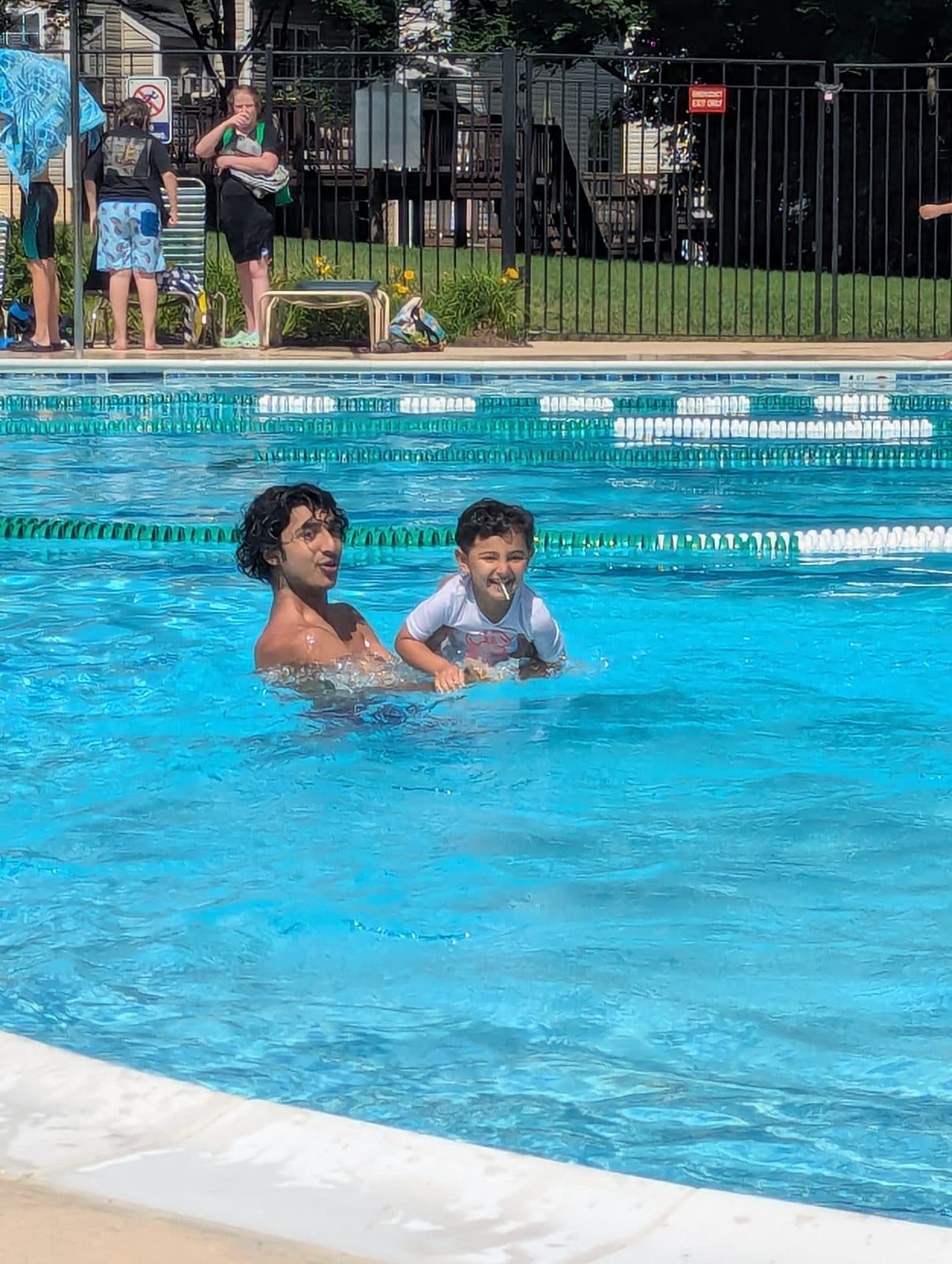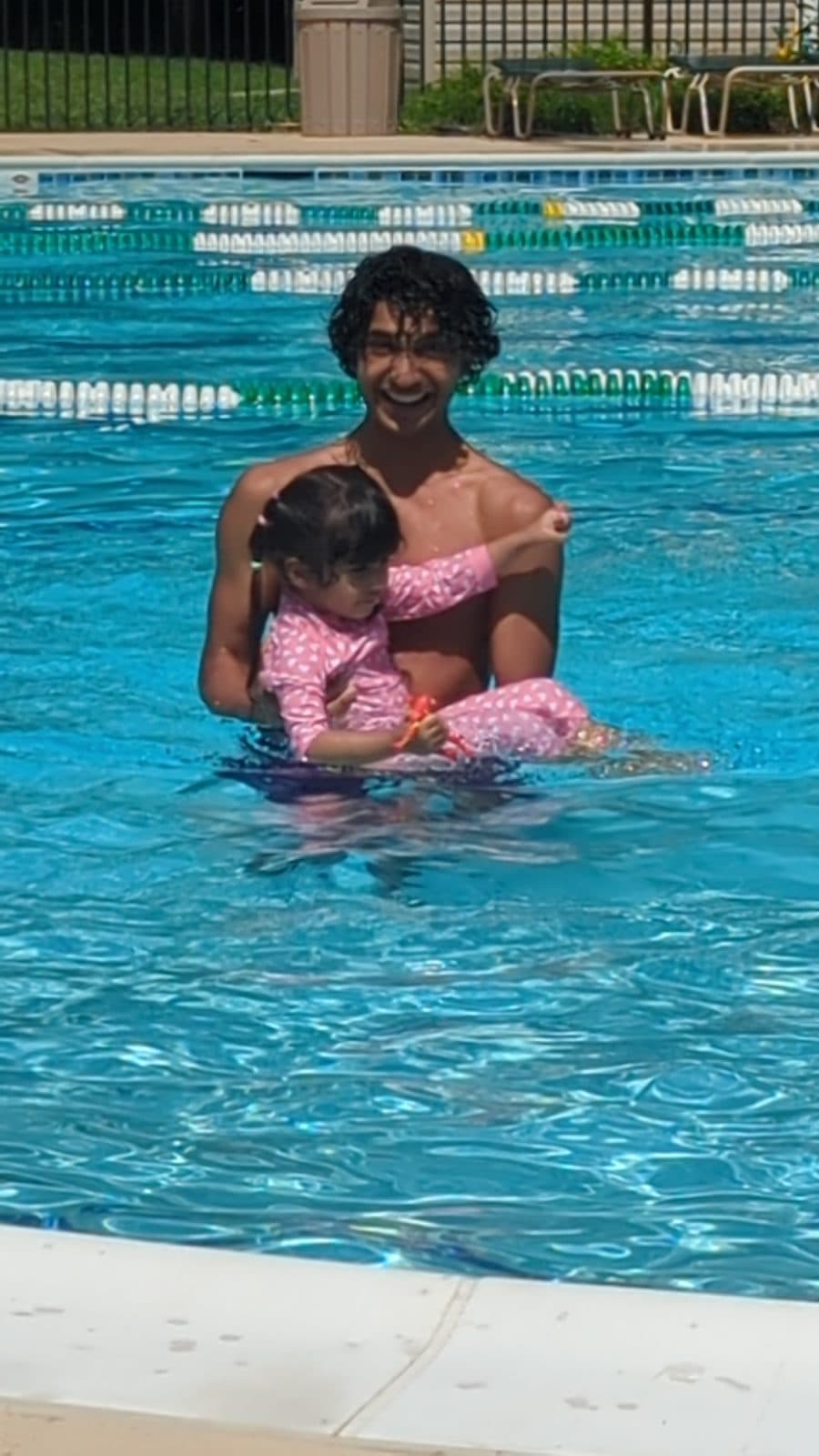
The short answer, by age
There is no single perfect age, but there is clear guidance. The American Academy of Pediatrics states that swimming lessons can begin for many children from age one, that by age four most children are developmentally ready to learn to swim, and that by age five or six most can master the front crawl.
The Academy is also clear about the other end of the scale: there is no evidence that infant swimming programmes for babies under one year of age reduce drowning risk. Baby classes have real value, but water safety is not the reason to book them.
Below is what each age band actually looks like in a private lesson, and what a parent in Dubai should expect from it.
Babies under one year
Lessons for babies are about comfort and familiarity, not about swimming. Rehan Ahmad teaches from six months, with a parent in the water throughout, and the goal for this age is simply that water becomes an ordinary, pleasant place to be.
A session at this age covers supported floating on the back and front, gentle kicking, pouring water over the head so it stops being a surprise, and blowing bubbles. Sessions are short in terms of real activity even within the hour, because babies tire quickly.
Set expectations accordingly. A baby who is relaxed in the water at ten months will find learning to swim at three far easier than a child meeting a pool for the first time. That is the honest benefit, and it is worth having. What it is not is a safety measure, and no baby should ever be considered water safe.
Ages one to three
This is where formal lessons start to change outcomes. A study by the National Institute of Child Health and Human Development found that formal swimming lessons were associated with an 88 per cent reduction in drowning risk among children aged one to four.
At this age a parent is usually still in the water, and the lesson works around the child rather than a syllabus. Rehan builds water comfort first, then assisted floating and kicking, bubble blowing and first submersions.
Toddlers do not learn on a schedule. One will jump in on week two and another will spend four lessons sitting on the step, and both are normal. A private lesson matters more at this age than any other, because the pace can follow the child exactly rather than the child having to follow the class.
Ages four to six
Four is the age the AAP identifies as the point when most children are developmentally ready to learn to swim, and it shows in the lessons. A four-year-old can hold an instruction in mind, repeat a movement deliberately, and understand why a skill matters.
In practice this is when children move from being comfortable in water to being able to do something about it. The skills in this band are independent floating and treading water, the basics of freestyle and backstroke, getting in and out safely, and self-rescue: turning around, getting back to the wall, and holding on.
By five or six, according to the same guidance, most children can master the front crawl. If your child is in this range and has never had lessons, this is the ideal window and progress is usually quick.
School age and later starters
Children who start at seven, nine or twelve are not behind, and they often move faster than younger beginners. They are stronger, they can follow a technical correction, and they are motivated by reasons they understand, such as a school swimming requirement, a pool party or a family holiday.
The one real difference is self-consciousness. An older beginner who cannot yet swim will usually not want to learn in front of a group of younger children who can. A private lesson at your own pool removes that problem entirely, which is often the deciding factor for this age.
For teenagers the split is usually between late beginners catching up and competent swimmers who want technique, turns and endurance. Both are taught in the same one-hour private format.
The water matters as much as the age
For very young children, water temperature is a genuine limiting factor rather than a comfort preference. The American Academy of Pediatrics advises that water for swimming classes for children aged three and under should be heated to between 87 and 94 degrees Fahrenheit, which is roughly 30.5 to 34.4 degrees Celsius.
Small bodies lose heat quickly, and a cold toddler will not learn anything. In Dubai this is mostly a winter question, since many villa and community pools run chillers in summer and heaters in winter.
Rehan checks the pool before a lesson with a baby or toddler and will say plainly if the water is too cold for a productive session. Rescheduling is better than a miserable hour.
Signs a child is ready to start
Readiness is easier to spot than it sounds. Age is a guide; the child in front of you is the real answer.
- They will get into the water, even reluctantly, without a struggle
- They can follow a simple two-step instruction
- They are willing to get their face wet, or at least tolerate it
- They can be apart from a parent for a few minutes without distress, for ages four and up
- They have enough stamina for a session without becoming exhausted or cold
Why waiting has a cost
The World Health Organization records around 300,000 drowning deaths a year worldwide, with children under five making up nearly a quarter of them. Drowning is the fourth leading cause of death for ages one to four and the third for ages five to fourteen.
Regionally the picture is sharper. Drowning rates among children aged zero to four are highest in the WHO Eastern Mediterranean Region, which includes the United Arab Emirates, at 16.8 per 100,000. Teaching school-age children basic swimming, water safety and safe rescue skills is one of the interventions the WHO explicitly recommends.
None of that means a lesson at six months is urgent. It means that in a city where pools are part of almost every residential building, delaying past four or five without a good reason carries a real cost.
Starting late is not starting too late
Adults who never learned as children make up a steady share of the swimmers Rehan teaches in Dubai, and they learn. The skill is not age-restricted; only the pace and the teaching method change.
If you are booking for an older child or for yourself, the free 30-minute intro call is the place to say so. Rehan plans the first lesson around where the swimmer actually is, not around where a syllabus says they should be at that age.